Research
Read the Research Product Sharing Plan
Watch the first webinar Introducing the MSCollaboratory
In this webinar hosted by the Gordon and Betty Moore Foundation on Feb 20, 2024 we highlighted how the project will contribute to your research by providing trainings and resources to apply mass spectrometry-based approaches that will facilitate the understanding of your system at the molecular level.
Submitted MassIVE Datasets
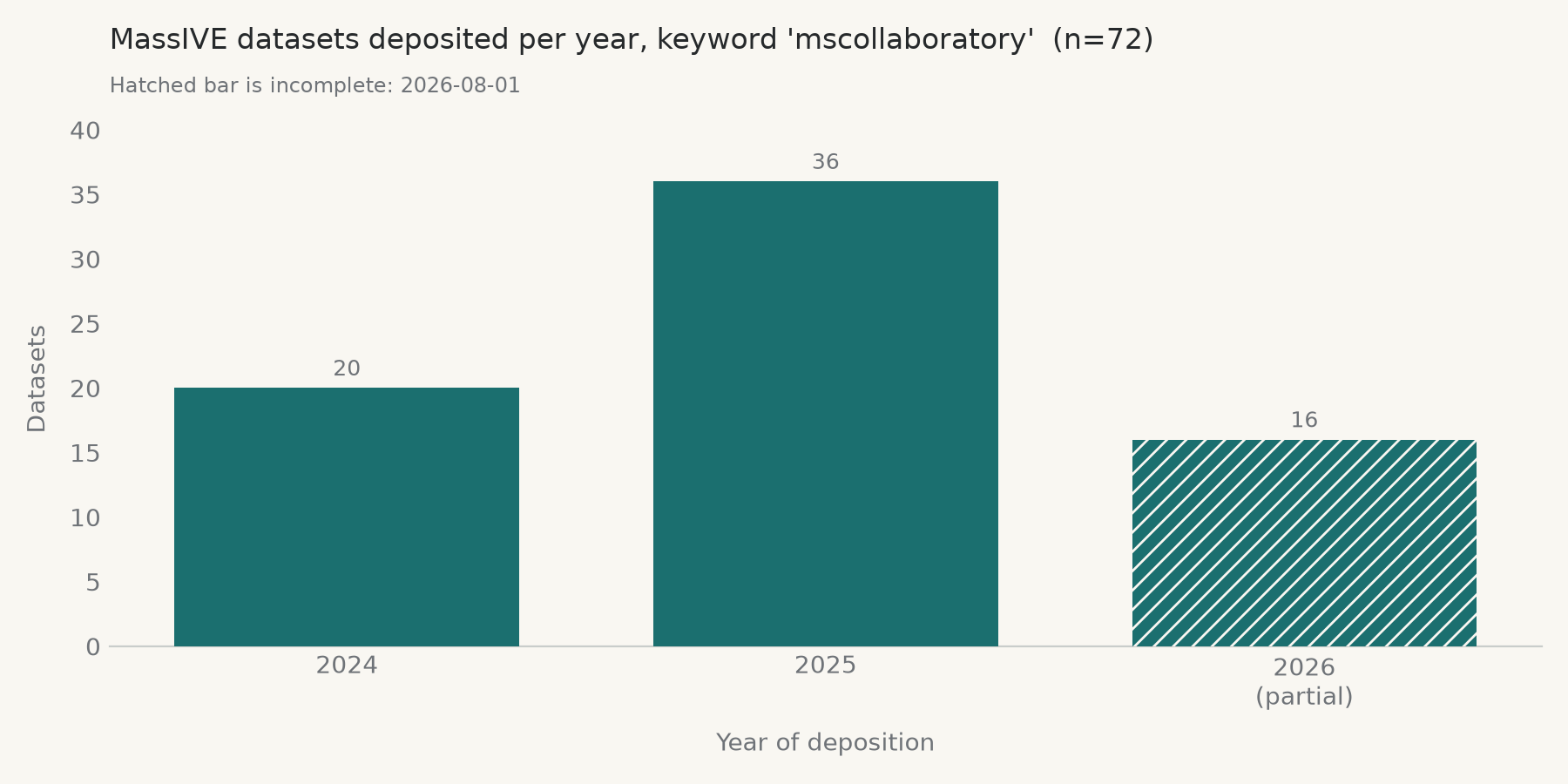
Visit the MassIVE repository (filtered by "mscollaboratory" under keywords) to access the datasets collected under the MSCollaboratory initiative [Analysis and figure credits: Wilhan Nunes and Mauricio Caraballo].
From Molecules to Metabolomes, Understanding Symbiosis through Small Molecules
https://pubs.acs.org/doi/10.1021/acs.jnatprod.5c01360
Abstract. Symbiosis, from Greek “living together” refers to the close association among organisms. Although these associations are found everywhere in nature, we do not know how these relationships are established or maintained over time. In this Perspective, we will focus on interorganism interactions involving microbes and eukaryotic hosts, particularly animals, plants, and humans, where symbiosis plays a critical role in health, development, and ecological fitness. We will focus on the chemical crosstalk between host and symbiont mediated by specialized small molecules. Finally, we suggest some steps for applying mass spectrometry-based metabolomic approaches to accelerate the understanding of these complex interactions.
Sea urchin eggs contain a plastid-derived structure that contributes to their development
https://journals.plos.org/plosbiology/article?id=10.1371/journal.pbio.3003705
Abstract. Development in the sea has long been thought to be a nutritional gamble that disproportionately ends in starvation. Here, we support the premise that components of plastids appear to be incorporated into sea urchin eggs and that these, in turn, benefit development. We find chromoplast-derived carotenoid crystals and chromoplast-specific metabolites inside the eggs of the sea urchin Arbacia lixula. We find evidence of plastid DNA in the eggs of 11 other sea urchins, with diatoms being the primary source and taxonomic richness of these plastid taxa directly related to egg size. The light-dependent activity of these chromoplast components influences phytohormone and lipid metabolism as well as offspring development, morphological plasticity, and survival. Offspring that benefit from these chromoplast components are predicted to disperse further, over larger geographic areas, and use a wider range of currents, including those that cross ocean basins. Data presented here challenge the long-held belief that components of non-metazoan organelles are unable to enter the germline and be passed between generations. We hypothesize that sea urchins manipulate plastids solely for their self-interest with the result of this process being a novel and adaptive form of maternal provisioning.
Large-scale discovery platform enables identification of peptides targeting drug-resistant candidiasis
https://www.cell.com/cell-reports-methods/fulltext/S2667-2375(26)00211-0Highlights
- We develop NPDiscover, a platform for identifying bioactive natural products
- NPDiscover combines genome mining, metabolomics, and machine learning
- NPDiscover identifies edaphochelin A by scanning extracts of Actinobacteria species
- Edaphochelin A shows in vivo efficacy against drug-resistant C. auris
Summary
Natural products have an unparalleled track record as sources of clinical drugs. Among them, nonribosomal peptides (NRPs) stand as one of the most therapeutically significant classes, encompassing numerous approved anti-infective and anticancer agents. Yet, discovering bioactive NRPs remains profoundly challenging due to their complex biosynthesis and chemical architecture. Here, we present NPDiscover, a pathogen-oriented, scalable bioinformatics platform that integrates genome mining, metabolomics, and machine learning to identify NRPs active against drug-resistant pathogens. Applying NPDiscover to Actinobacteria datasets, we discovered edaphochelin A, a previously unreported NRP that kills multi-drug-resistant Candida auris and Candida glabrata by disrupting respiratory chain proteins. Structural elucidation via nuclear magnetic resonance and mass spectrometry, alongside in vitro and in vivo validation, confirmed its efficacy, safety, and a mode of action distinct from existing antifungals—establishing edaphochelin A as a compelling drug candidate and NPDiscover as a powerful engine for scalable natural product discovery.
The undiscovered natural product potential of Actinomycetes
https://www.nature.com/articles/s41429-025-00876-x
With our LC-MS/MS-based approach we provide further evidence of the potential that Actinomycetes have to produce small molecules.
Some key messages from this piece of work:
- This is a large dataset of untargeted liquid chromatography tandem mass spectrometry (LC-MS/MS) from 948 microbial strains, already part of microbeMASST
- The dataset is publicly available to the scientific community
- Our analysis provides evidence of the vast potential of discovery of microbial molecules (see Fig 2)
- We applied the latest computational approaches in the field of metabolomics to provide curated annotation of microbial molecules (some of you are familiar with the lack of reference spectra for identification of molecules), a great contribution to the CMMC knowledgebase
- We provide use of the dataset to highlight its value for discovery of microbial molecules by demonstrating the detection of recently discovered non-ribosomal peptides and analogues.
This work also provided the opportunity for learning, training (e.g., culturing techniques, sample preparation, data acquisition, data analysis) and applying untargeted metabolomics approaches by undergrads, grads, postdocs and visiting scholars, in line with the goals of the MSCollaboratory.
Wonderful and collaborative work, thank you all the co-authors
And wait for more exciting research outcomes here!
Accelerating Metabolomic Analysis of Aquatic Symbioses
MSCollaboratory